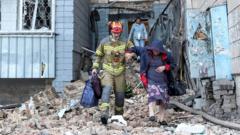
At least 15 killed in Kyiv as Ukraine grapples with air‑defence shortages – On Thursday, a coordinated strike hit residential blocks and a warehouse district in Kyiv, killing at least 15 civilians and injuring dozens more. Ukrainian officials blamed the devastation on a “massive attack” that exposed critical gaps in the capital’s anti‑missile shield. The assault comes as Kyiv’s air‑defence network struggles to replace aging Soviet‑era systems, raising urgent questions about civilian safety and the pace of Western support. The incident underscores how supply shortfalls can translate into lethal consequences for ordinary people.
Key takeaways
- At least 15 civilians died after a large‑scale missile barrage struck Kyiv’s flats and warehouses.
- Ukraine’s air‑defence inventory is running low on modern interceptors, forcing reliance on older Soviet stock.
- The attack highlights the widening gap between Russia’s missile capacity and Kyiv’s dwindling shield.
- International partners face pressure to accelerate deliveries of Patriot, NASAMS and other high‑end systems.
Background
Since February 2022, Ukraine has depended heavily on foreign air‑defence kits to blunt Russia’s high‑precision strikes. Early in the war, the United States, the United Kingdom and several EU members supplied Patriot and IRIS‑T systems, but replenishment cycles have lagged behind the intensity of attacks. According to a recent report from the Ukrainian Ministry of Defence, the country’s stock of S‑300 and Buk missiles is projected to run out within months if new deliveries stall.
The shortfall has forced Ukrainian forces to recycle spent interceptors and stretch existing batteries across multiple fronts. Analysts note that this “use‑and‑reuse” strategy, while ingenious, reduces the overall reliability of the shield and leaves key urban zones, such as Kyiv’s densely populated districts, more vulnerable. For a fuller look at how Ukraine’s defence challenges intersect with broader geopolitical trends, see our coverage of the world arena.
What happened
On Thursday evening, Russian‑launched Iskander‑M and Kalibr missiles slammed into two residential high‑rise blocks in the Svyatoshyn district and a logistics warehouse on the outskirts of Kyiv. Witnesses described a “roaring” sound followed by bright flashes that illuminated the night sky. Emergency services rushed to the scene, but the sheer scale of the impact overwhelmed local responders.
Ukrainian officials confirmed that at least 15 people were killed and many more were treated for shrapnel wounds and burns. The government’s emergency ministry released preliminary figures, emphasizing that the death toll could rise as rescue teams continue to search collapsed structures. The attack was characterised by the Defence Ministry as a “massive attack” that exploited known gaps in the city’s layered defence architecture.
Why it matters
The loss of civilian life in Kyiv reverberates far beyond the immediate tragedy. First, it signals a shift in Russian targeting strategy toward densely populated areas, increasing pressure on Ukraine’s political leadership to protect its citizens. Second, the incident exposes the limits of current air‑defence inventories, prompting NATO allies to reassess the speed and volume of future shipments. Third, the psychological impact on Kyiv’s residents—already living under a constant threat of bombardment—could erode public morale and hamper the nation’s resolve to continue the fight.
In the broader context, the strike may influence diplomatic calculations in the West. Lawmakers in Washington and Brussels have begun debating whether to approve additional funding for Patriot and NASAMS systems, a debate that mirrors discussions in domestic policy circles, such as the recent Reform UK proposes tax rebates for firms to boost apprenticeships article. The outcome could determine the pace at which Ukraine can rebuild its shield.
Deeper analysis
Air‑defence supply chain bottlenecks
Ukraine’s reliance on foreign hardware creates a complex logistics web. Production lines for Patriot missiles in the United States and NASAMS in the Netherlands are already operating at capacity, with back‑orders for spare parts extending into 2025. Compounding the issue, Russia’s own missile production has accelerated, delivering a higher volume of Iskander and Kalibr weapons than anticipated.
Tactical adjustments on the ground
Ukrainian commanders have begun re‑configuring their limited assets, concentrating mobile Buk-M1 batteries around critical infrastructure while pulling older S‑300 units toward the capital’s periphery. These moves, however, stretch crews thin and increase the risk of mis‑identification during high‑tempo engagements.
Civilian resilience and adaptation
Since the war’s outset, Kyiv residents have adopted “red‑alert” drills, seeking shelter in subway stations and reinforced basements. Yet the latest strike revealed that even deep shelters can be compromised when multiple missiles strike simultaneously. Community organisations are now lobbying municipal authorities for more hardened shelters, echoing similar civilian‑defence initiatives seen in other conflict zones.
For readers interested in the technological side of defence, the Apollo Atomics wants to make nuclear power cheaper by shrinking an overlooked part piece offers insight into how innovative engineering can offset broader security spending.
What happens next
Ukraine’s President is expected to convene an emergency meeting with NATO representatives within the next 48 hours. Sources close to the Chronicle News editorial desk suggest that the discussion will focus on fast‑tracking Patriot battery deliveries and expanding training programmes for Ukrainian operators.
In parallel, the Ukrainian Ministry of Defence has announced a request for an additional 30 Stinger and Igla‑S man‑portable air‑defence units to protect low‑altitude zones around Kyiv’s schools and hospitals. If approved, these systems could provide a stop‑gap measure while larger platforms await shipment.
International donors are also reviewing budget allocations. The European Union’s European Peace Facility is rumored to earmark an extra €200 million for air‑defence procurement, a move that could bridge the short‑term gap but will still require parliamentary ratification in member states.
Finally, humanitarian agencies are scaling up medical response capabilities, deploying field hospitals to the most affected districts. The coordination between civil defence and health services will be crucial in limiting the death toll from future attacks.
Frequently asked questions
How many missiles were used in the Thursday attack?
Ukrainian officials have not released an exact count, but preliminary assessments suggest at least four cruise missiles and two ballistic missiles struck the city.
What types of air‑defence systems does Kyiv currently rely on?
Kyiv’s shield is a layered mix of legacy Soviet S‑300 and Buk batteries, supplemented by limited Patriot and NASAMS units supplied by NATO allies.
When can Ukraine expect additional air‑defence deliveries?
Delivery timelines vary; Patriot batteries are slated to arrive in late 2024, while NASAMS and short‑range systems may be dispatched within the next six months, depending on production capacity and political approvals.
Bottom line
The deadly Thursday strike on Kyiv starkly illustrates how Ukraine’s air‑defence shortages translate into civilian casualties. The episode intensifies pressure on Western partners to accelerate military aid, as reported by BBC News.
Related reading
- Reform UK proposes tax rebates for firms to boost apprenticeships
- Apollo Atomics wants to make nuclear power cheaper by shrinking an overlooked part
- Closer to retiring than changing teams - why Verstappen stayed at Red Bull
- Danone €1bn takeover of Huel approved by watchdog
- German neo‑Nazi suspected of deadly 1970 fire at Jewish retirement home