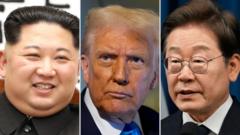
BBC breaks down Trump's latest shift on North and South Korea
President Donald Trump announced on Thursday that the United States will “substantially reduce” joint military drills with South Korea, citing his “very good relationship” with North Korean leader Kim Jong Un. The statement was made during a press briefing in Washington, D.C., and marks a sharp departure from the long‑standing U.S. policy of regular combined‑forces exercises on the Korean Peninsula. The pivot could reshape regional security dynamics, affect U.S. alliances, and influence diplomatic negotiations with both Pyongyang and Seoul.
Key takeaways
- Trump promises to cut back joint U.S.–South Korea drills, highlighting personal ties with Kim Jong Un.
- The move challenges decades‑long deterrence strategy that has underpinned regional stability.
- Analysts warn reduced training may embolden North Korea’s missile and nuclear programs.
- Washington’s shift could pressure allies to reassess security commitments in East Asia.
Background
Since the Korean War armistice in 1953, the United States has conducted annual combined‑forces exercises with South Korea, most recently the “Foal Eagle” and “Ulchi Freedom Guardian” drills. These maneuvers are designed to ensure readiness against a potential North Korean attack and to reassure Seoul of U.S. commitment. Over the past year, Trump’s administration has oscillated between hard‑line sanctions and diplomatic overtures, including historic summits with Kim Jong Un in 2018 and 2019. The latest announcement follows a series of stalled negotiations over denuclearisation and a renewed focus on “peace through strength” rhetoric in the White House.
What happened
During a Thursday press conference, Trump told reporters that the United States would “substantially reduce” the scale and frequency of joint exercises with South Korea. He emphasized that his “very good relationship” with Kim Jong Un allows for a new approach to security on the peninsula. The President did not specify a timeline or the exact size of the reduction, but he indicated that future drills would be “more limited and focused.” The remark was immediately picked up by the world desk of Chronicle News, sparking debate among policymakers and defense experts.
Why it matters
The announcement carries several implications:
- Deterrence calculus – Reduced drills could lower the readiness of U.S. and South Korean forces, potentially altering Pyongyang’s risk assessment.
- Alliance confidence – Seoul may question the reliability of the U.S. security umbrella, prompting discussions about autonomous defence capabilities.
- Regional power balance – China and Russia could interpret the shift as an opening to increase their influence in the Korean Peninsula.
- Diplomatic leverage – By linking exercise reductions to personal rapport with Kim, Trump may be testing whether a softer stance can extract concessions on nuclear disarmament.
The move also arrives as Washington grapples with other security challenges, from the Russia warns UK over supplying drones to Ukraine to ongoing debates about trade and technology. Observers note that the decision aligns with Trump’s broader “America First” narrative, which often prioritises bilateral relationships over multilateral frameworks.
What happens next
- Seoul’s response – South Korean President Yoon Suk‑yeol is expected to convene his National Security Council within days to formulate a response, possibly demanding assurances before any exercise cutbacks take effect.
- Congressional scrutiny – U.S. lawmakers may call for hearings to assess the strategic impact of the reduction, especially given the Pentagon’s budget constraints.
- North Korean posture – Pyongyang could either view the announcement as a diplomatic victory or as an opportunity to accelerate its weapons program, depending on subsequent U.S. actions.
- Future negotiations – The U.S. may leverage the reduced drills as a bargaining chip in forthcoming talks on denuclearisation, though critics warn that goodwill alone cannot replace concrete verification mechanisms.
Stakeholders will be watching closely for any formal memorandum of understanding that codifies the new exercise regime. In the meantime, the Pentagon’s public affairs office has pledged to release a detailed schedule within the next week.
Frequently asked questions
How much will the joint exercises be reduced?
Trump’s statement did not include exact figures; officials said the reduction will be “significant” but will retain essential training components.
Does this signal a broader U.S. policy shift toward North Korea?
The announcement reflects a personal diplomatic angle rather than an official policy overhaul, but it may foreshadow a more flexible U.S. approach if progress on denuclearisation materialises.
What impact could this have on South Korea’s security?
South Korea may seek to bolster its own forces or request alternative security guarantees from Washington, but the exact impact will depend on how quickly the new exercise plan is implemented.
Bottom line
President Trump’s pledge to cut back joint U.S.–South Korea drills marks a notable shift in East Asian security policy, hinging on his personal rapport with Kim Jong Un. The move will be closely monitored by allies, adversaries, and Congress for its strategic repercussions.
*Reporting by