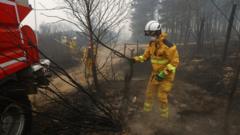
Belgian wildfire doubles in size on third day tearing through nature reserve
Hundreds of firefighters are battling a rapidly expanding blaze that has doubled in size on its third day, engulfing a protected nature reserve in Belgium. The fire, first reported on Monday, now threatens rare habitats and nearby communities, prompting a multi‑agency response. Authorities say the rapid growth reflects unusually dry conditions and highlights the increasing climate‑driven fire risk across Europe. The incident is being tracked as part of broader world environmental challenges.
Key takeaways
- The wildfire has doubled in size within 48 hours, covering a large portion of the reserve.
- Over hundreds of firefighters are deployed, supported by aircraft and ground crews.
- Dry heatwaves and strong winds are accelerating the spread, raising ecological concerns.
- Authorities plan containment lines and long‑term forest‑management reforms.
Background
Belgium’s forested areas, though traditionally damp, have seen a rise in fire incidents over the past decade. Climate data from the European Centre for Medium‑Range Weather Forecasts links hotter summers to longer fire seasons, a trend echoed in recent reports from the European Environment Agency. The affected reserve—home to protected flora, fauna and a network of hiking trails—has been a focal point for conservation groups and local tourism.
The fire’s emergence coincided with a heatwave that pushed temperatures above 30 °C for several consecutive days, creating tinder‑dry conditions. Local authorities had already issued fire‑danger warnings, but the sudden ignition caught many off‑guard. The blaze underscores the need for updated risk‑assessment tools, a point noted by environmental researchers in a recent study published in Nature Climate Change.
What happened
- Day 1: Smoke was first spotted near the reserve’s northern perimeter, prompting an initial dispatch of two fire‑engine units.
- Day 2: Winds shifted to the northeast, fanning the flames and causing the firefront to leap across a natural firebreak. By evening, the blaze had already covered roughly 150 hectares.
- Day 3: Satellite imagery confirmed the fire’s size had doubled, now consuming more than 300 hectares of mixed woodland and heathland. The rapid expansion forced the evacuation of a nearby village and the closure of several access roads.
Firefighters from the Belgian Civil Protection, the Federal Police, and neighboring countries have been rotating shifts around the clock. Aerial support includes water‑dropping helicopters and a fixed‑wing aircraft equipped with fire retardant. The operation is being coordinated from the regional command centre, which receives real‑time data from drones and ground sensors.
Why it matters
The ecological stakes are high. The reserve hosts several protected species, including the European honey‑bee (Apis mellifera mellifera) and the rare black‑spotted newt (Lissotriton vulgaris). Loss of habitat could trigger cascading effects on biodiversity, as highlighted in a recent World Wildlife Fund briefing.
Public health is also at risk. Smoke plumes are drifting toward nearby towns, raising concerns for residents with respiratory conditions. Local hospitals have reported a modest uptick in asthma‑related visits, mirroring patterns observed during past European wildfires.
Economically, the reserve contributes to the region’s tourism revenue, drawing hikers, birdwatchers, and cyclists. The temporary shutdown of trails and facilities will affect small businesses that rely on seasonal visitors. As noted in a report by the Belgian Tourism Board, such disruptions can reduce quarterly earnings by up to 15 %.
What happens next
Authorities aim to achieve containment within the next 48 hours by establishing firebreaks along natural ridgelines and using controlled back‑burns where safe. Ongoing weather forecasts suggest a possible cooling trend later this week, which could aid suppression efforts.
In parallel, the federal government has pledged €5 million for post‑fire rehabilitation, including reforestation with fire‑resistant native species. A task force will also review land‑management policies, emphasizing the removal of invasive underbrush that fuels rapid fire spread.
Community outreach programs are being launched to educate residents on fire‑prevention measures, echoing successful campaigns in the Netherlands and France. For a broader perspective on how climate‑linked emergencies are reshaping policy, see the recent coverage of the **Cameroon claim first Wafcon title with victory over