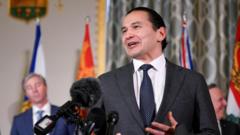
Manitoba Premier Wab Kinew has called on Canada to stand firm as a critical US trade deadline approaches, urging the federal government to protect the country’s economic interests. Speaking on Friday, Kinew emphasized the importance of resisting pressure to concede on key trade issues, adding that Prime Minister Mark Carney faces an uphill battle in securing public support for any deal. The looming deadline, tied to renegotiations of the Canada-US trade framework, could reshape industries across both nations. With time running out, the stakes are high for Canada’s economy and its position within international trade.
Key Takeaways
- Manitoba Premier Wab Kinew urged Canada to resist US demands in trade negotiations.
- The trade deadline could impact key sectors like agriculture and manufacturing.
- Prime Minister Mark Carney is navigating public skepticism over trade concessions.
- US-Canada relations are strained as industries brace for potential disruptions.
Background
Canada and the United States have long been deeply intertwined through trade agreements such as the USMCA (United States-Mexico-Canada Agreement). However, recent negotiations have sparked tensions, with Washington reportedly seeking concessions that could affect Canadian industries like agriculture, forestry, and manufacturing. Manitoba, a province reliant on exports to the US, has been particularly vocal about the potential repercussions of an unfavorable deal.
Premier Kinew’s comments underscore growing concern among provincial leaders, who fear the economic fallout if Canada is forced to compromise. The federal government, led by Prime Minister Mark Carney, must now navigate political and economic pressures while maintaining a unified front in the negotiations.
What Happened
On the eve of the US trade deadline, Wab Kinew publicly called for Canada to adopt a tougher stance. Speaking in Winnipeg, he said, “Our industries, jobs, and communities depend on trade agreements that work for Canadians. We should fight for what’s right, not settle for less.”
The remarks came as negotiators from both sides worked to resolve sticking points, including agricultural subsidies and intellectual property protections. Reports suggest that the US is pushing for measures that could disproportionately benefit American producers, leaving Canadian exporters at a disadvantage.
Kinew’s statement reflects broader unease among provincial leaders, who worry that concessions could weaken Canada’s economic resilience. His call for resistance adds pressure on Prime Minister Carney, who is already grappling with public skepticism regarding the federal government’s approach to the talks.
Why It Matters
The outcome of these trade negotiations could significantly impact Canada’s economy, particularly in provinces heavily reliant on exports to the US. Manitoba’s agricultural and manufacturing sectors, for instance, could face reduced access to the US market if unfavorable terms are agreed upon.
Moreover, the political implications are equally significant. Prime Minister Carney must balance international diplomacy with domestic concerns, as Canadians grow increasingly wary of the potential fallout from a rushed deal. With economic growth slowing and inflation pressures mounting, a misstep in these negotiations could exacerbate existing challenges.
This trade tension also highlights the fragility of US-Canada relations, which have faced increased strain in recent years. The stakes are especially high as both countries aim to maintain economic stability while addressing global challenges like climate change and supply chain disruptions.
What Happens Next
As the deadline approaches, Prime Minister Carney and his team are expected to ramp up efforts to secure a deal that meets Canada’s needs. However, any agreement will require approval from Parliament, where opposition parties may scrutinize concessions.
Provincial leaders like Kinew are likely to continue voicing their concerns, potentially influencing the government’s negotiation strategy. Meanwhile, industries across Canada are bracing for potential disruptions, with many closely monitoring developments in sectors like agriculture and manufacturing.
The US, too, faces pressure to finalize a deal, as its own industries depend on stable trade relations with Canada. With time running out, both nations will need to find common ground or risk economic uncertainty that could ripple through North America.
Frequently Asked Questions
What is the US trade deadline about?
The US trade deadline pertains to ongoing negotiations to update aspects of the Canada-US trade framework, including provisions within the USMCA. These talks aim to address evolving economic conditions, but disagreements over key issues have made the process contentious.
How could this affect Canadian industries?
If unfavorable terms are agreed upon, Canadian industries like agriculture, forestry, and manufacturing could face reduced competitiveness in the US market. This could lead to job losses, lower exports, and economic instability in affected provinces.
What are provincial leaders saying about the negotiations?
Provincial leaders like Wab Kinew are urging the federal government to adopt a tougher stance, warning that concessions could hurt local economies. Their concerns reflect broader public skepticism about the potential impact of the trade deal.
Bottom Line
The looming US trade deadline has put Canada in a challenging position, with Manitoba Premier Wab Kinew calling for a tougher stance. Prime Minister Mark Carney must navigate complex negotiations while addressing domestic concerns. BBC News reports the outcome could shape economic relations across North America.