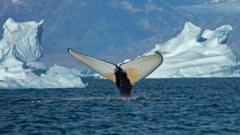
Giant whales move into Greenland waters as ice disappears
The Arctic’s summer thaw is drawing massive whales into Greenland’s once‑frozen seas, where they are staging unprecedented “feeding frenzies.” Scientists from the University of Copenhagen first recorded the shift in July 2026, noting that the whales are following the retreat of sea‑ice that once blocked their migration routes. The phenomenon signals a dramatic re‑shaping of marine ecosystems and raises fresh concerns for climate‑policy makers worldwide.
Key takeaways
- Melting Arctic ice this summer opened new feeding grounds for humpback and fin whales.
- Researchers observed dozens of whales congregating near the Ilulissat Icefjord for the first time.
- The shift may alter predator‑prey dynamics, affecting fish stocks and local fisheries.
- Scientists warn that continued warming could push more species into unfamiliar Arctic waters.
Background
Greenland’s coastal waters have been encased in multi‑year sea ice for millennia, creating a natural barrier that limited the range of large cetaceans. Over the past decade, satellite data have shown a steady decline in ice thickness, a trend accelerated by rising global temperatures. Climate models from the Intergovernmental Panel on Climate Change (IPCC) predict that the Arctic could be nearly ice‑free in summer within the next 30 years, reshaping marine habitats across the high north.
What happened
In late June, a team of marine biologists from the Arctic Research Centre spotted a pod of humpback whales feeding near the town of Qeqertarsuaq. Over the following weeks, the group grew to include fin whales, minke whales, and even a rare sighting of a blue whale—one of the largest mammals on Earth. The whales were observed surfacing in rapid succession, a behavior scientists describe as a “feeding frenzy” triggered by the sudden abundance of krill and small fish that have migrated northward with the retreating ice.
The discovery was documented in a field report posted to the world section of our site, where researchers highlighted the rapidity of the change: “Within weeks, we went from no sightings to a dense aggregation of several species.” The findings echo earlier reports of climate‑driven wildlife shifts, such as the story on Trump threatens 'tremendous economic consequences' on any country helping Iran that examined geopolitical ripple effects of environmental policy.
Why it matters
The arrival of giant whales into Greenland’s waters carries ecological, economic, and cultural implications. Ecologically, whales are apex feeders; their presence can suppress certain fish populations while boosting others through nutrient recycling. For local communities that rely on fishing, a sudden change in predator numbers could disrupt catches of cod and shrimp, threatening livelihoods.
From a scientific perspective, the event offers a rare, real‑time laboratory to study how marine megafauna adapt to rapid habitat alteration. It also underscores the urgency of climate mitigation: the same warming that melts ice also fuels extreme weather events far beyond the Arctic.
What happens next
Researchers plan to launch a year‑long acoustic monitoring program to track whale movements throughout the Arctic summer. Meanwhile, Greenland’s Ministry of Fisheries is convening a stakeholder workshop to assess potential impacts on commercial fishing and tourism. International bodies, including the International Whaling Commission, are being urged to update migration maps and consider protective measures for newly established feeding grounds.
For ongoing coverage of climate‑driven wildlife shifts, readers can explore more stories on Chronicle News or browse all articles.
Frequently asked questions
How many whale species have been observed in Greenland’s waters this year?
Scientists have recorded at least four species—humpback, fin, minke, and a solitary blue whale—since the ice began to melt in June.
Will the whales stay in Greenland year‑round?
Most likely not; they are expected to leave as winter sea ice reforms, but some individuals may linger longer if food remains abundant.
What can local communities do to adapt to the new marine dynamics?
Fisheries are encouraged to diversify target species and collaborate with researchers on sustainable catch limits that account for the new predator presence.
Bottom line
The sudden influx of giant whales into Greenland’s waters illustrates how climate change is rapidly reshaping Arctic ecosystems, with far‑reaching consequences for wildlife and human economies. The reporting is based on findings from BBC News.
Related reading
- Trump threatens 'tremendous economic consequences' on any country helping Iran
- [Missing teen hiker found dead in Australian bush after eight‑day search](/articles/missing-teen-hiker-found-dead-australian-bush-eight-day-search?