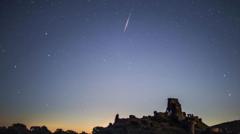
Perseid meteor shower reaches peak: When and where to catch a glimpse
The Perseid meteor shower will hit its zenith on the night of Wednesday, 12 August, offering stargazers a prime window to spot bright “shooting stars.” The celestial display, generated by debris from comet Swift‑Tuttle, is visible across the Northern Hemisphere, with the best viewing conditions after local midnight when the radiant point rises higher in the sky. Astronomers and casual observers alike are watching because the peak promises up to 100 meteors per hour, a spectacular reminder of Earth’s place in a dynamic solar system. For those planning a night under the stars, knowing the exact timing, location and safety tips can turn a simple walk outside into a memorable experience.
Key takeaways
- Peak activity occurs Wednesday night, 12 August, from roughly 02:00 – 04:00 UTC.
- Dark, rural sites away from city lights give the clearest view of the Perseids.
- The radiant lies in the constellation Perseus, rising high after midnight.
- Meteor‑watching apps and local astronomy clubs can help you spot the most meteors.
Background
The Perseids are one of the most reliable and prolific annual meteor showers, a tradition dating back to ancient Chinese records. Each year, Earth’s orbit intersects the dust trail left by comet Swift‑Tuttle, a 13‑kilometre‑wide icy body that last visited the inner solar system in 1992. As the planet sweeps through this stream of particles, they burn up in the atmosphere, producing the fleeting streaks of light that have fascinated humans for millennia.
Modern observers benefit from a wealth of data collected by professional observatories and citizen‑science networks. According to the BBC News report, the 2026 peak is expected to be slightly brighter than average, thanks to a denser dust filament encountered this year. The phenomenon also offers a practical teaching moment for educators in the science field, who can link astronomy to topics like orbital mechanics, atmospheric chemistry and cultural history.
What happened
On Wednesday night, the Perseid radiant will sit just above the constellation Perseus, which arches high in the northern sky after midnight. Observers in the United States, Canada, Europe and parts of Asia will see the meteors streak across a broad swath of the sky, moving from the northeast toward the southwest.
The shower’s intensity is measured in “ZHR” (Zenithal Hourly Rate), a theoretical maximum if the radiant were at the zenith and the sky completely dark. This year’s ZHR is projected at ~100, meaning that under perfect conditions an observer could count up to a hundred meteors in a single hour. Cloud cover, moonlight and light pollution will all lower that number, which is why experts advise heading to dark‑sky reserves or rural locations well away from city glow.
Local astronomy clubs have already begun organizing public viewing events. For example, the Chronicle News calendar lists a pop‑up telescope night at the County Observatory, where volunteers will guide newcomers through the basics of meteor spotting and answer questions about the Perseids’ origin.
Why it matters
Beyond its visual appeal, the Perseid peak provides valuable scientific data. Each meteor that vaporises deposits trace elements—such as iron, magnesium and sodium—into the upper atmosphere, influencing ionospheric chemistry. Researchers use spectroscopic measurements from ground‑based cameras to study these elemental signatures, improving models of atmospheric heating and satellite drag.
The event also serves as a low‑cost public engagement platform. By inviting people onto rooftops, parks and school fields, astronomers can inspire the next generation of scientists and engineers. In a year when headlines range from Trump Media reports $238m loss as crypto falls to OpenAI reportedly completed a $7 billion employee tender offer, the timeless wonder of a meteor shower offers a grounding perspective on humanity’s place in the cosmos.
Deeper analysis
Atmospheric conditions
The clarity of the Perseid display hinges on several atmospheric variables. Transparency—the absence of haze or dust—allows fainter meteors to be seen, while seeing (the steadiness of the air) affects how sharply a meteor’s trail appears. Meteorologists predict a high‑pressure system over much of the Northern Hemisphere on 12 August, which typically brings clear skies and low humidity—a favorable combo for stargazing.
Light‑pollution mitigation
Even modest street lighting can wash out the faintest meteors. The International Dark‑Sky Association (IDA) recommends using a red‑light flashlight to preserve night‑vision, and turning off any personal lights when the meteor rate peaks. Mobile apps such as SkySafari and Star Walk now include “dark‑sky maps” that highlight nearby low‑light‑pollution zones, helping users locate the optimal spot within minutes.
Cultural resonance
Historically, the Perseids have been interpreted as omens or messages from the heavens. In Greek mythology, the shower is linked to the hero Perseus, while medieval European chronicles described “stars falling like rain” as portents of war or plague. Modern scientists, however, view these celestial fireworks as a reminder of Earth’s dynamic environment—an opportunity to reflect on climate change, satellite debris and the sustainability of space activities.
What happens next
After the peak, the Perseid rate will gradually decline over the following two nights, tapering to a background level of roughly 10–15 meteors per hour by 14 August. Astronomers will continue to monitor the shower with all‑sky cameras, feeding data into the International Meteor Organization’s (IMO) database. The next major meteor shower of note will be the Orionids in late October, also sourced from comet Swift‑Tuttle, giving enthusiasts another chance to compare particle density and composition across the year.
For those who missed the peak, many observatories archive live streams of the meteor shower, allowing viewers to replay the event at their convenience. Educational platforms are already preparing lesson plans that incorporate the Perseids into curricula on orbital dynamics, encouraging teachers to use the real‑time data as a teaching tool.
Frequently asked questions
When is the best time to watch the Perseids?
The optimal window is between 02:00 – 04:00 UTC on 12 August, when the radiant is highest and the sky is darkest.
Do I need special equipment to see the meteors?
No—bare eyes are sufficient. A reclining chair, a blanket, and a red‑light flashlight are all you need for a comfortable viewing experience.
How can I tell the difference between a Perseid and a satellite?
Meteors streak quickly (lasting a fraction of a second) and often leave a bright, glowing trail, whereas satellites move steadily across the sky without a flash.
Bottom line
The Perseid meteor shower will peak on Wednesday night, offering a rare chance to witness dozens of shooting stars across the Northern Hemisphere. This celestial event combines scientific value with public wonder, reinforcing the importance of dark‑sky preservation.
Reporting by BBC News.
Related reading
- Trump Media reports $238m loss as crypto falls
- Disabled in a heatwave: 'We're talking about survival'
- OpenAI reportedly completed a $7 billion employee tender offer
- As AI-led attacks multiply, OpenAI launches a new cyber model
- 'I started in my 20s and made £8,000': Why women are often better investors than men