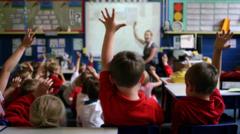
Thousands helped with back‑to‑school costs
More than £310,000 has been distributed to families across England to offset the rising price of uniforms, stationery and transport, the Department for Education announced on 12 September 2024. The funding, part of the government’s annual back‑to‑school grant scheme, reaches over 4,500 households in deprived areas. Officials say the aid comes at a crucial time as inflation squeezes household budgets, making it easier for children to start the term fully equipped. The move highlights the Treasury’s renewed focus on education spending within the broader business agenda.
Key takeaways
- Over £310,000 allocated, supporting more than 4,500 families with essential school items.
- Funds targeted at low‑income households in England’s most deprived local authority districts.
- Scheme administered through local authorities and charities, ensuring rapid distribution.
- Government vows to monitor impact and consider expanding the grant in future budgets.
Background
Since 2020, the UK government has run a voluntary back‑to‑school grant scheme, but funding levels have varied year‑on‑year. Last year, the programme was paused due to fiscal pressures, leaving many families to shoulder full costs. Rising inflation in 2023‑24 pushed the price of a basic school uniform above £150, prompting renewed calls from charities and school leaders for a national safety net. The latest allocation follows the 2024 Spring Budget, which earmarked additional resources for education equity.
What happened
On 12 September, the Department for Education released a statement confirming that £310,000 would be disbursed through local councils, community groups and school‑based charities. Recipients were selected using the Pupil Premium eligibility criteria, ensuring that children already identified as vulnerable receive the extra support. The rollout began on 15 September, with families receiving vouchers, direct cash transfers, or school‑supplied kits, depending on local arrangements. The programme is being tracked on a live dashboard accessible via the government portal, allowing transparent oversight.
Why it matters
The grant tackles several intersecting challenges. First, it reduces the risk of children missing lessons because they cannot afford uniforms—a factor linked to lower attendance and academic performance. Second, it eases financial pressure on families already coping with higher energy bills, as reported by the BBC News. Third, the initiative signals a policy shift toward targeted fiscal support within the business sector, aligning education spending with broader economic recovery plans. The move also mirrors strategies seen in other programmes, such as the apprenticeship tax rebates discussed in Reform UK proposes tax rebates for firms to boost apprenticeships.
What happens next
Local authorities will continue to verify eligibility and distribute remaining vouchers through the next two weeks. The Department for Education has pledged a review in early 2025 to assess uptake, impact on attendance rates, and any administrative bottlenecks. If the pilot proves successful, ministers may consider scaling the grant to cover secondary‑school costs, which are typically higher. Stakeholders are encouraged to follow updates on the Chronicle News homepage, where detailed case studies and feedback from parents will be published.
Frequently asked questions
How were families selected for the grant?
Eligibility mirrors the Pupil Premium criteria, focusing on children from households receiving free school meals or child tax credits.
Will the grant cover secondary‑school expenses as well?
The current funding applies only to primary‑school costs; a separate consultation on secondary‑school support is slated for early 2025.
How can I find out if my child received a voucher?
Parents can check with their local council’s education department or log onto the online portal referenced in the funding announcement.
Bottom line
The government’s £310,000 back‑to‑school grant reaches thousands of families, easing the cost burden for the new academic year. The initiative underscores a strategic push to protect education outcomes amid rising living costs, as reported by BBC News.
Related reading
- At least 15 killed in Kyiv as Ukraine grapples with air defence shortages
- Reform UK proposes tax rebates for firms to boost apprenticeships
- Apollo Atomics wants to make nuclear power cheaper by shrinking an overlooked part
- Closer to retiring than changing teams - why Verstappen stayed at Red Bull
- Danone €1bn takeover of Huel approved by watchdog