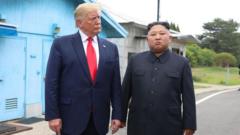
Trump says US to scale back South Korea military drills after it stayed out of Iran war
Former President Donald Trump announced on Thursday that the United States will reduce the scope of its joint military exercises with South Korea. He framed the move as a response to Seoul’s decision to remain neutral in the escalating conflict between Iran and its regional adversaries. Trump also highlighted his “very good relationship” with North Korean leader Kim Jong‑un as a factor that allows a more limited drill schedule. The statement, made during a press briefing in Washington, could reshape the security calculus on the Korean Peninsula and reverberate across the broader Indo‑Pacific region.
Key takeaways
- Trump links the scaling‑back of drills to South Korea’s non‑involvement in the Iran war.
- The former president cites a personal rapport with Kim Jong‑un as a diplomatic lever.
- Reduced exercises may alter deterrence dynamics against North Korea and Iran‑aligned forces.
- The policy shift arrives as allies reassess security commitments amid multiple crises.
Background
The United States and South Korea have conducted annual joint training, known as “Freedom Edge” and “Foal Eagle,” for more than two decades. These drills are designed to improve interoperability, test missile defenses, and demonstrate a united front against North Korean aggression. In recent years, the exercises have been expanded to include cyber and space components, reflecting evolving threats.
At the same time, the Middle East has been gripped by a war that began when Iran launched a series of missile and drone attacks in retaliation for Israeli strikes. The conflict has drawn in regional powers, but South Korea has publicly declared its intention to stay out of the hostilities, focusing instead on its own security challenges.
Trump’s comment arrives amid a broader debate within the U.S. defense establishment about the cost‑effectiveness of large‑scale drills, especially as Washington redirects resources to counter China’s growing maritime presence.
What happened
During a Thursday briefing, Trump said, “We’re going to scale back the drills with South Korea because they stayed out of the Iran war. I have a very good relationship with Kim Jong‑un, and that makes it possible to do less.” He added that the United States would continue to maintain a “strong defensive posture” but would “focus on quality over quantity.”
The announcement was not accompanied by a formal defense department memo, and no immediate changes to the 2024 exercise schedule were released. However, Pentagon spokespeople confirmed that a review of the joint training calendar is under way, citing “regional stability” as a guiding principle.
Why it matters
The decision touches on three interlocking security concerns:
- Deterrence on the Korean Peninsula – Scaling back drills could be interpreted by Pyongyang as a weakening of the U.S.–South Korea alliance, potentially emboldening its missile program.
- Allied cohesion – Seoul’s neutral stance on the Iran war has already strained its ties with Washington; a reduced training footprint may deepen that rift.
- Global perception – The move signals a willingness to adjust traditional security arrangements based on diplomatic relationships, a message that could influence other U.S. partnerships in Europe and the Indo‑Pacific.
Analysts note that the United States has historically used joint exercises as a bargaining chip in broader negotiations, from the Cold War to the present day.
Deeper analysis
Diplomatic calculus
Trump’s reference to his “very good relationship” with Kim Jong‑un reflects a personal diplomatic approach that differs from the institutional channels usually employed by the State Department. While former President Trump engaged in high‑profile summits with the North Korean leader in 2018 and 2019, the tangible outcomes of those meetings remain contested. By invoking that relationship, Trump suggests that a softer stance on drills could open a back‑channel for future talks on denuclearization.
Regional ripple effects
South Korea’s decision to stay out of the Iran war has already prompted criticism from Israel and Gulf states, which view Tehran’s aggression as a direct threat. A reduction in U.S.‑South Korean drills may be read as tacit approval of Seoul’s neutrality, potentially encouraging other allies to adopt a similar posture in unrelated conflicts.
Conversely, a scaled‑back exercise schedule could free up U.S. forces for rapid deployment elsewhere, such as reinforcing NATO’s eastern flank or bolstering the Quad’s maritime patrols.
Military readiness
Critics argue that cutting back on large‑scale drills risks eroding the high‑level coordination required to counter a North Korean invasion. Proponents counter that modern warfare increasingly relies on technology and joint command structures that can be rehearsed in smaller, more focused events.
The Pentagon’s ongoing review will likely weigh the trade‑offs between force readiness and resource allocation, a balance that has been highlighted in recent defense budget debates.
Media and public reaction
The announcement sparked a flurry of commentary across outlets. Some U.S. journalists, such as those at BBC News, noted the potential diplomatic leverage but warned of unintended security gaps. South Korean media emphasized the need for a transparent dialogue with Washington to avoid misinterpretations.
For readers interested in how unrelated high‑profile events are covered, see the story about Ferrari's first ever electric car sold for record $40m at auction and the aftermath of natural disasters like About 100 homes swept away after Hurricane Lala lashes Hawaii.
What happens next
The Pentagon is expected to issue a formal statement within the next week, outlining any adjustments to the 2024 joint training calendar. South Korean officials have pledged to discuss the matter with the United States in a bilateral security forum slated for early September.
If the drills are indeed reduced, allied forces may seek alternative mechanisms—such as multinational tabletop exercises or virtual simulations—to maintain interoperability.
Washington’s broader strategic roadmap, which includes a pivot to the Indo‑Pacific and a focus on high‑tech warfare, will likely shape the final decision. Observers will watch closely for any signals that the United States intends to use the drill reduction as leverage in future talks with North Korea or as a gesture of goodwill toward Tehran’s regional allies.
Frequently asked questions
Why did Trump link the drill reduction to South Korea’s stance on the Iran war?
He framed the decision as a response to Seoul’s neutrality, suggesting that U.S. military cooperation can be adjusted based on a partner’s geopolitical choices.
Does a “very good relationship” with Kim Jong‑un guarantee peace on the Korean Peninsula?
While personal rapport can open dialogue channels, lasting peace requires formal agreements, verification mechanisms, and broader diplomatic support.
Will the United States still protect South Korea if North Korea escalates?
Trump affirmed that the United States will maintain a “strong defensive posture,” indicating that core security guarantees remain intact despite any drill changes.
Bottom line
Trump’s proposal to scale back U.S.–South Korea drills reflects a diplomatic pivot that could reshape regional security dynamics. The move underscores the interplay between alliance politics and broader geopolitical conflicts, as reported by BBC News.
Related reading
- Ferrari's first ever electric car sold for record $40m at auction
- About 100 homes swept away after Hurricane Lala lashes Hawaii
- If Meta loses this trial, Instagram and Facebook could change forever
- McIlroy admits concerns as Scheffler regains winning feeling at St Jude
- How switching your bank account could earn you up to £220
For more coverage, visit the world section or browse all stories on Chronicle News.