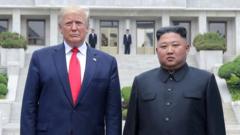
U.S. military exercises with South Korea concluded abruptly on Friday, sparking questions about the region’s security dynamics. Former President Donald Trump’s past overtures to North Korean leader Kim Jong Un have resurfaced as a point of contention, with experts warning that South Korea might bear the brunt of any concessions. The timing is critical, as North Korea is reportedly in a position of military and strategic strength. This development could reshape alliances and heighten tensions in East Asia.
Key takeaways
- U.S.-South Korea military drills ended unexpectedly early on Friday, raising security concerns.
- Trump’s history of courting Kim Jong Un complicates U.S. alliances in East Asia.
- North Korea is believed to have strengthened its military capabilities significantly.
- South Korea could face heightened risks amid shifting U.S. foreign policy priorities.
Background
For decades, the Korean Peninsula has been a focal point of geopolitical tension, with North Korea’s nuclear ambitions drawing global attention. Joint military exercises between the U.S. and South Korea are a cornerstone of their alliance, aimed at deterring aggression from Pyongyang. However, during Trump’s presidency, he sought to engage directly with Kim Jong Un, holding historic summits but achieving no concrete denuclearization agreements.
The exercises, which typically last several weeks, are often condemned by North Korea as provocations. This week, they ended early, a move that analysts say could signal a shift in U.S. priorities.
What happened
On Friday, U.S.-South Korea military exercises wrapped up ahead of schedule. The Pentagon has not provided a detailed explanation, but the decision comes as North Korea shows signs of increased military readiness. The North recently unveiled new missile systems and conducted launches, signaling its growing capabilities.
Speculation is mounting that Trump’s influence, including his past overtures to Kim, could be impacting U.S. policy in the region. Trump has repeatedly praised his “good relationship” with Kim, even calling him a "friend." Critics argue this approach undermines the U.S.-South Korea alliance and emboldens Kim’s regime.
Why it matters
The abrupt end to the exercises has raised alarms about the U.S.’s commitment to its allies in East Asia. South Korea, in particular, could face heightened risks as North Korea strengthens its military and continues weapons testing. Pyongyang’s growing arsenal includes intercontinental ballistic missiles capable of reaching the U.S. mainland, amplifying global security concerns.
Trump’s past dealings with Kim also complicate matters. While his efforts to build a personal rapport with the North Korean leader were unprecedented, they yielded little in terms of denuclearization or improved regional security. Critics fear that such a conciliatory approach could lead to concessions that weaken South Korea’s position.
What happens next
The conclusion of the military drills raises questions about the future of U.S.-South Korea cooperation. It remains unclear whether this signals a broader policy shift or is an isolated decision. Analysts warn that South Korea may need to bolster its own defenses as uncertainty grows around U.S. commitments.
Meanwhile, North Korea is likely to exploit the situation, using the scaled-back drills as propaganda to assert its strength. As the region recalibrates, South Korea’s leadership will face mounting pressure to navigate this precarious landscape.
Frequently asked questions
Why did the military drills end early?
The Pentagon has not provided a detailed explanation for the early conclusion of the exercises. Analysts speculate it could be tied to diplomatic considerations or a desire to avoid further antagonizing North Korea.
How does this affect South Korea?
South Korea may face increased military and political risks if U.S. commitments waver. The abrupt end to the drills could embolden North Korea and force South Korea to reassess its defense strategies.
What is Trump’s role in this?
During his presidency, Trump sought to establish a personal rapport with Kim Jong Un, which some argue weakened U.S.-South Korea ties. His approach continues to influence perceptions of U.S. policy in the region.
Bottom line
The early end to U.S.-South Korea military drills raises serious concerns about regional stability and the future of alliances in East Asia. Reporting sourced from BBC News.
Related reading
- Two teenagers seriously injured after sword attack at Swedish school
- Russell takes pole position for Dutch GP sprint race
- High court allows rugby brain injury case to go on
- Ethiopia's Virgin Mary festival in Tigray cancelled over drone strike fears
- Ex-England bowler Cross to retire at end of summer
Explore more stories in the world section or browse all articles on Chronicle News.