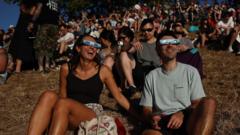
Millions of residents across the United Kingdom and Europe witnessed a rare solar eclipse on Thursday morning, a celestial phenomenon that captivated sky-gazers despite occasional cloudy conditions. The eclipse began shortly after 10 a.m. BST, with the moon partially obscuring the sun, creating a striking visual spectacle. The once-in-a-generation event drew attention from amateur astronomers, photographers, and curious onlookers, underscoring its scientific significance and universal appeal. While some regions reported clear skies, others contended with overcast weather, limiting visibility for many.
Key takeaways
- Solar eclipse occurred across UK and Europe, peaking around 10 a.m. BST on Thursday.
- Cloudy conditions in parts of the UK hampered visibility for some viewers.
- The event is considered a rare celestial occurrence, last seen in this form years ago.
- Astronomers highlighted its importance in understanding Earth’s relationship with celestial bodies.
Background
Solar eclipses occur when the moon passes between the Earth and the sun, temporarily blocking sunlight from reaching the planet. While partial eclipses happen more frequently, total eclipses—where the sun is entirely obscured—are less common and often draw global attention. Thursday’s eclipse was a partial one, with varying degrees of coverage visible across Europe depending on geographic location and weather conditions.
Astronomers and scientists frequently use eclipses as opportunities for research, studying phenomena such as solar corona behavior and atmospheric effects. Historically, such events have also played a role in cultural and scientific storytelling, inspiring curiosity about the cosmos.
What happened
The solar eclipse began mid-morning and lasted for several hours, with the moon casting its shadow over large parts of Europe. In the UK, areas such as northern Scotland reported better visibility, while southern England experienced a mix of clear and cloudy skies. Observers armed with special eclipse glasses and telescopes set up in parks and observatories to catch a glimpse of the rare event.
In Scotland, eclipse watchers battled challenging weather conditions, though some regions enjoyed clearer views. Cloudy skies lead to mixed fortunes for Scotland's eclipse hunters. Across the continent, millions tuned in to livestreams or stepped outdoors to witness the moon partially obscure the sun, creating a surreal twilight effect in certain areas.
Why it matters
This eclipse offered a unique opportunity for scientists and sky-watching enthusiasts to observe one of nature’s most striking phenomena. For astronomers, events like these provide critical information about the sun’s corona, solar activity, and the moon’s orbital path.
Beyond its scientific implications, the solar eclipse also serves as a reminder of humanity’s place within the vast expanse of the universe. Millions in UK and Europe left wowed by once-in-a-generation solar eclipse highlights the awe-inspiring nature of these events, with many viewers finding a sense of connection to the cosmos.
What happens next
The next solar eclipse visible in parts of Europe is expected in 2027, with astronomers already preparing for the event. In the meantime, researchers will analyze data collected during Thursday’s eclipse to further understand solar phenomena and lunar dynamics.
For those who missed this week’s event, it serves as a reminder to stay informed and prepare for future celestial occurrences. The science community continues to emphasize the importance of public engagement with astronomy, fostering both education and inspiration.
Frequently asked questions
What is a solar eclipse?
A solar eclipse occurs when the moon passes between the Earth and the sun, temporarily blocking sunlight from reaching the planet. Depending on the alignment, the eclipse can be partial, annular, or total, each offering a unique viewing experience.
How often do solar eclipses happen?
Solar eclipses occur roughly 2-5 times a year somewhere on Earth. However, a total eclipse visible in a specific location is far rarer, happening only once every few decades.
Is it safe to look at a solar eclipse?
No, it is not safe to look directly at the sun during an eclipse without proper protection. Special eclipse glasses or filters should be used to avoid permanent eye damage.
Bottom line
The solar eclipse over UK skies provided a moment of awe for millions, reminding us of the beauty and mystery of the cosmos. Reporting attributed to BBC News.
Related reading
- Cloudy skies lead to mixed fortunes for Scotland's eclipse hunters
- Millions in UK and Europe left wowed by once-in-a-generation solar eclipse
- ICE plans to equip agents with gloves that can deliver electric shocks
- Chelsea set Friday deadline over £120m Fernandez
- Fernandes the centre of attention - but what next for Man Utd captain?