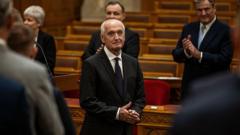
A former judge ousted by Viktor Orbán's government has been elected Hungary's new president, marking a dramatic political shift. The election took place earlier this week in Budapest and signals a potential dismantling of Orbán's long-standing influence. The new administration, which took office in May, has prioritized reversing controversial policies associated with the previous regime. This development could have far-reaching implications for Hungary's political landscape and its relationship with the European Union.
Key takeaways
- Former judge previously removed by Orbán's government elected as Hungary's president in a historic vote.
- New administration, in office since May, aims to reverse several controversial Orbán-era policies.
- Election underscores growing opposition to Orbán's influence in Hungary's political system.
- Potential ramifications for Hungary's relations with the European Union and rule-of-law standards.
Background
Viktor Orbán has dominated Hungarian politics for over a decade, consolidating power through sweeping constitutional changes and controversial judicial reforms. Critics have accused his government of undermining democratic institutions and cracking down on dissent. A notable example of this was the removal of independent-minded judges, including the newly elected president, during Orbán’s tenure.
For years, the European Union criticized Hungary under Orbán for its perceived erosion of democratic norms, leading to tensions between Budapest and Brussels. The election of a president with a history of opposition to Orbán's policies marks a stark departure from the status quo.
What happened
The new Hungarian president was elected in a parliamentary vote earlier this week, defeating an Orbán-aligned candidate. This victory followed months of growing public dissatisfaction with the previous administration's handling of the judiciary and media freedoms.
Since taking office in May, the current government has quickly moved to undo several of Orbán's policies, including reforms that critics said weakened judicial independence. The newly elected president, who once served as a judge before being ousted by Orbán’s administration, has pledged to restore the rule of law and rebuild trust in Hungary's democratic institutions.
Why it matters
This election represents a pivotal moment in Hungary's political evolution, as it signals a clear pushback against Orbán's long-standing dominance. The new president's victory highlights a shift in public and parliamentary sentiment, reflecting a growing demand for democratic reforms.
The implications extend beyond Hungary’s borders. The European Union, which has repeatedly clashed with Orbán's government over rule-of-law issues, may view this development as an opportunity to rebuild relations with Budapest. It also raises questions about the future direction of Hungarian politics and whether this marks a permanent break from Orbán's era of governance.
What happens next
The new president and government are expected to focus on rolling back Orbán-era policies and restoring judicial autonomy. Legislative reforms will likely be introduced to strengthen democratic institutions and address EU concerns about governance in Hungary.
However, the road ahead is not without challenges. Orbán's political party still holds significant influence in Hungary, and the opposition may face obstacles in implementing their agenda. Additionally, the president’s ability to enact change will depend on continued public support and cooperation with European partners.
Frequently asked questions
Who is the newly elected Hungarian president?
The new president is a former judge who was removed from their position during Viktor Orbán’s tenure. Their election represents a stark shift in Hungarian politics, with a focus on restoring democracy and judicial independence.
Why was the new president previously removed by Orbán?
The new president was ousted as part of Orbán’s judicial reforms, which critics argued were designed to consolidate his power. Their removal was emblematic of broader efforts to limit judicial independence during Orbán’s rule.
How might this affect Hungary’s relationship with the EU?
The election could improve Hungary’s strained relations with the European Union, as the new administration has expressed commitment to addressing EU concerns over the rule of law. However, progress will depend on tangible legislative changes and sustained dialogue.
Bottom line
The election of a former judge removed by Viktor Orbán as Hungary's president marks a significant political shift. This development could reshape Hungary’s future and its relationship with the European Union. Reporting by BBC News.
Related reading
- Google’s Gemini app surges to one billion users
- Criticism of empty seats and ticket prices at the Europeans
- Are ticket prices to blame for 'disappointing' European Championship attendance?
- 'Phenomenal!' - GB's Shanahan wins European 200m backstroke gold
- Jaissle 'bit scared' how refs will take 'emotional' touchline style