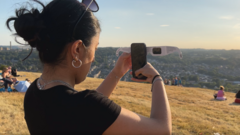
Thousands of people across Yorkshire gathered in cities like York, Leeds, and Bradford on Saturday to witness the most significant solar eclipse in the UK since 1999. The rare event, which partially obscured the sun, drew spectators armed with telescopes, protective glasses, and cameras. The celestial phenomenon, which took place between 10:00 AM and 12:30 PM, captivated onlookers and sparked renewed interest in astronomy. Experts have hailed the event as a moment to reflect on the wonders of the universe and the importance of science education.
Key Takeaways
- Thousands gathered in Yorkshire cities to witness the rare solar eclipse.
- The eclipse was the most significant in the UK since 1999.
- Events across York, Leeds, and Bradford drew families and amateur astronomers.
- The eclipse reignited public enthusiasm for astronomy and space science.
Background
A solar eclipse occurs when the moon passes between the Earth and the sun, casting a shadow that partially or fully obscures the sun. While total solar eclipses are rare, partial eclipses like the one seen in Yorkshire on Saturday occur more frequently, providing a unique opportunity for people to witness the alignment of celestial bodies. The last major solar eclipse visible in the UK was in 1999, making this weekend’s event a significant moment for astronomy enthusiasts.
The British Astronomical Association and local science organizations encouraged the public to view the event safely using proper solar viewing glasses or indirect viewing methods, like pinhole projectors. Schools and families also participated, using the opportunity to educate younger generations about the science behind eclipses.
What Happened
As the skies dimmed on Saturday morning, crowds gathered in popular viewing spots such as York’s Clifford’s Tower, Leeds’ Millennium Square, and Bradford’s City Park. Despite intermittent clouds, the eclipse was visible for much of the two-hour event, with the moon covering up to 25% of the sun at its peak.
Local astronomy clubs set up telescopes for public use, while experts explained the science behind the phenomenon. The event created a festive atmosphere, with families, students, and tourists sharing in the rare experience. Enthusiastic participants described the eclipse as "magical" and "a reminder of how small we are in the universe."
Footage from the event, including dramatic time-lapse videos, has been widely shared on social media. For those unable to attend, live streams of the eclipse were broadcast online, drawing thousands of additional viewers.
Why It Matters
The eclipse offered a chance to connect with the natural world and sparked a renewed interest in science, particularly astronomy. Events like this serve as an important reminder of the role science plays in understanding our place in the universe.
Moreover, the eclipse brought communities together, with people of all ages and backgrounds gathering to witness the same awe-inspiring spectacle. As the UK prepares for future astronomical events, this collective enthusiasm could encourage more investment in science education and public engagement.
The timing of this event also coincides with broader discussions about climate change and the importance of scientific literacy. Experts hope that the growing public interest in celestial phenomena can translate into greater attention to science-related challenges on Earth.
What Happens Next
While the next partial solar eclipse visible in the UK is not expected until 2025, astronomy enthusiasts won’t have to wait long for another celestial event. A lunar eclipse will occur in March, providing another opportunity for stargazers to marvel at the cosmos.
In the meantime, local science organizations and astronomy clubs are planning follow-up events to sustain public interest. Schools and universities across Yorkshire are also expected to incorporate lessons on eclipses and space science into their curriculums. For those who missed this weekend’s event, educational resources and footage are available online, including this video of the eclipse.
Frequently Asked Questions
What is a solar eclipse?
A solar eclipse happens when the moon passes directly between the Earth and the sun, blocking the sun's light. Depending on the alignment, the eclipse can be total, partial, or annular.
Was the eclipse visible across the UK?
Yes, the eclipse was visible across most of the UK, although the level of coverage varied by location. In Yorkshire, the moon obscured up to 25% of the sun.
How can I safely view an eclipse?
To view a solar eclipse safely, use certified solar viewing glasses or indirect methods like a pinhole projector. Never look directly at the sun without proper protection, as it can cause permanent eye damage.
Bottom Line
The solar eclipse over Yorkshire delighted thousands, offering a rare opportunity to witness a celestial event while renewing interest in science. Reporting by BBC News.
Related Reading
- Watch: Solar eclipse seen over UK skies
- Members of Trump's cabinet remained on decoy plane, after president's quiet exit
- Trump says White House press secretary Karoline Leavitt to leave post
- ICE plans to equip agents with gloves that can deliver electric shocks
- MI London and Welsh Fire eliminated from knockouts