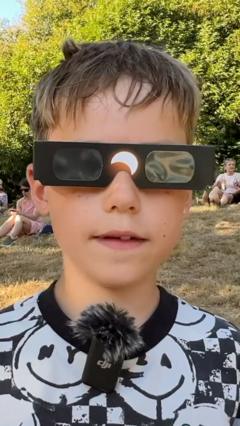
An 8-year-old boy, Jacob, witnessed a rare solar eclipse, calling it a "moment he'll never forget." The celestial event occurred on Saturday, drawing global attention as millions paused to marvel at the phenomenon. Jacob, speaking to reporters, described his excitement about seeing the moon pass in front of the sun, creating a fleeting yet magical alignment. This event highlights the importance of science in inspiring young minds and fostering curiosity about the universe.
Key Takeaways
- Jacob, 8, expressed awe after witnessing Saturday's rare solar eclipse.
- Millions around the world paused to view the extraordinary celestial event.
- Solar eclipses offer unique opportunities for education and scientific discovery.
- Jacob's experience underlines the power of science to inspire future generations.
Background
Solar eclipses occur when the moon passes directly between the Earth and the sun, temporarily blocking the sun's light. Saturday’s eclipse was a partial eclipse visible across parts of North, Central, and South America. These events are significant for both astronomers and the general public, offering a rare chance to observe cosmic alignments in action.
For families like Jacob's, the eclipse provided a way to engage children in science, connecting them to the wonders of the natural world. The event has been widely celebrated as a moment to inspire curiosity and learning, especially among young enthusiasts.
What Happened
On Saturday, Jacob joined millions across the Americas to witness the solar eclipse. Equipped with protective glasses, he gazed at the sky as the moon partially obscured the sun, creating a striking visual spectacle. Jacob, describing the moment, said, "It felt like the world stopped for a second."
His family used this opportunity to teach him more about the science behind eclipses, blending the awe of the moment with educational value. The event was widely shared on social media, with photos and videos capturing the eclipse's effects on landscapes and skies.
Why It Matters
Solar eclipses are more than just visual marvels; they are critical for scientific observation and public engagement. Events like these provide opportunities to study the sun's outer atmosphere, or corona, in ways not possible during normal conditions.
For children like Jacob, witnessing such phenomena can ignite a lifelong interest in science and exploration. It also serves as a reminder of the vastness and interconnectedness of our universe, encouraging a sense of global unity as people stop to observe together.
What Happens Next
The next solar eclipse visible in parts of the Americas is set for April 2024, and it will be a total eclipse. Experts encourage families to prepare in advance, ensuring they have proper eye protection and access to educational resources.
Jacob’s experience underscores the importance of such preparation. His parents shared that they used the event to spark conversations about astronomy and space exploration, which they plan to continue leading up to the next eclipse.
Frequently Asked Questions
What is a solar eclipse?
A solar eclipse occurs when the moon passes between the Earth and the sun, partially or fully blocking sunlight. It can only happen during a new moon and is visible from specific parts of the Earth.
How can you safely watch a solar eclipse?
Solar eclipses should never be viewed with the naked eye. Special eclipse glasses or solar viewers are required to protect your vision. Regular sunglasses are not safe for eclipse viewing.
When is the next solar eclipse?
The next solar eclipse visible in parts of the Americas will occur on April 8, 2024. It will be a total eclipse, offering an even more dramatic experience than Saturday's partial eclipse.
Bottom Line
Jacob's excitement over witnessing a historic solar eclipse reminds us of the joy and inspiration that science can bring to young minds. This event, as reported by BBC News, highlights the power of celestial phenomena to unite and educate.
Related Reading
- Who really needs a cocktail robot?
- Palestinians told to leave homes in village where Israeli settlers besieged houses
- Four Canadian hockey stars remain suspended after sexual assault acquittal
- Swansea's Burgess looks set to miss entire season
- Apple in talks to pay publishers to provide Siri with current news: report