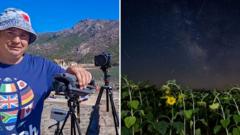
For many, witnessing a total solar eclipse is a rare, awe-inspiring event. But for a niche group of dedicated enthusiasts, chasing solar eclipses has become a lifelong passion and pursuit. These individuals travel to remote corners of the globe, enduring logistical challenges and unpredictable weather, all for a fleeting glimpse of the celestial phenomenon that lasts mere minutes. Their efforts shine a light on humanity's enduring fascination with the cosmos and our desire to connect with the universe.
Key Takeaways
- Solar eclipse chasers travel worldwide for moments of cosmic beauty and scientific significance.
- Logistical hurdles include unpredictable weather, remote locations, and high travel costs.
- The emotional payoff is often described as life-changing and deeply spiritual.
- Solar eclipses highlight humanity's connection to the universe and our thirst for exploration.
Background
A solar eclipse occurs when the moon passes between the Earth and the sun, temporarily blocking its light. Total solar eclipses, where the moon completely obscures the sun, create a breathtaking spectacle of a darkened sky, a glowing solar corona, and unique atmospheric effects. While eclipses occur somewhere on Earth around every 18 months, they are visible only within a narrow path called the "path of totality."
For most people, witnessing a total solar eclipse — such as the famed 2017 "Great American Eclipse" — is often a once-in-a-lifetime event. But for eclipse chasers, it is an addiction. They meticulously plan trips across continents, using calculations and predictions from astronomers to ensure their presence within the path of totality.
What Happened
Veteran eclipse chasers have described their travels as a mix of scientific curiosity, emotional fulfillment, and adventure. For many, the journey begins years in advance with planning around NASA's eclipse maps and weather forecasts.
One such enthusiast, Dr. Kate Russo, has traveled to over a dozen countries to experience total solar eclipses. Her passion began in 1999 during an eclipse in her home country of Northern Ireland. Since then, she has traveled to locations as remote as the Arctic and as tropical as Indonesia, often braving harsh elements and logistical challenges to catch mere minutes of darkness.
Chasers also emphasize the community aspect of eclipse tourism. Gatherings at eclipse sites often attract people from across the globe, including professional astronomers, photographers, and locals curious about the phenomenon. These connections and shared experiences add to the allure of eclipse chasing.
Why It Matters
Solar eclipses are not just breathtaking celestial events; they also hold significant scientific value. During totality, astronomers can study the sun's corona — the outermost layer of the sun's atmosphere — which is otherwise obscured by its overwhelming brightness during regular daylight.
Beyond science, eclipses offer a rare opportunity for people to connect with nature and the universe on a profound level. The phenomenon has been described as transformative, evoking feelings of awe and humility. This emotional impact has inspired many individuals, such as Dr. Kate Russo, to dedicate their lives to chasing eclipses around the globe.
Deeper Analysis
Eclipse chasing is not without its challenges. Travel costs can be exorbitant, as prime viewing locations often lie in remote areas without accessible infrastructure. Weather unpredictability is another major hurdle; cloud cover can ruin years of careful planning in an instant.
However, technology has made it easier for enthusiasts to prepare. Websites like NASA's eclipse portal provide detailed maps, while apps track weather forecasts in real time. Photography equipment has also evolved, allowing chasers to capture stunning images of the eclipse, which they often share with the science community and the public.
For many, the emotional rewards outweigh the difficulties. Witnesses often describe the experience as "otherworldly," with some even likening it to a spiritual awakening. This profound connection drives them to continue seeking out eclipses wherever they occur, whether in deserts, jungles, or icy tundras.
What Happens Next
The next total solar eclipse will occur on April 8, 2024, with its path of totality spanning parts of the United States, Mexico, and Canada. Eclipse chasers are already preparing to converge on prime viewing spots like Texas and the Yucatán Peninsula.
Experts anticipate an influx of tourists and scientists alike, eager to study the eclipse and experience its awe-inspiring beauty. Local governments in regions along the path of totality are gearing up to accommodate visitors, ensuring safe and memorable experiences for all.
Frequently Asked Questions
What is the "path of totality"?
The path of totality refers to the narrow geographic band where the moon completely obscures the sun during a total solar eclipse. This path is often only a few hundred kilometers wide and moves across the Earth's surface as the eclipse progresses.
Why are total solar eclipses so rare?
While solar eclipses occur somewhere on Earth about every 18 months, the narrow path of totality means they are not visible to everyone. Additionally, the alignment of the sun, moon, and Earth has to be exact for a total eclipse to occur, making them far less common than partial eclipses.
Is eclipse chasing expensive?
Yes, it can be costly, as it often involves international travel and specialized equipment for photography or observation. However, many enthusiasts find ways to budget their trips, such as booking flights well in advance or choosing affordable accommodations near eclipse sites.
Bottom Line
Chasing solar eclipses is more than just a hobby; it is a profound, life-enriching pursuit for many enthusiasts. As humanity continues to explore the cosmos, these events remind us of our deep connection to the universe. Reporting attributed to BBC News.