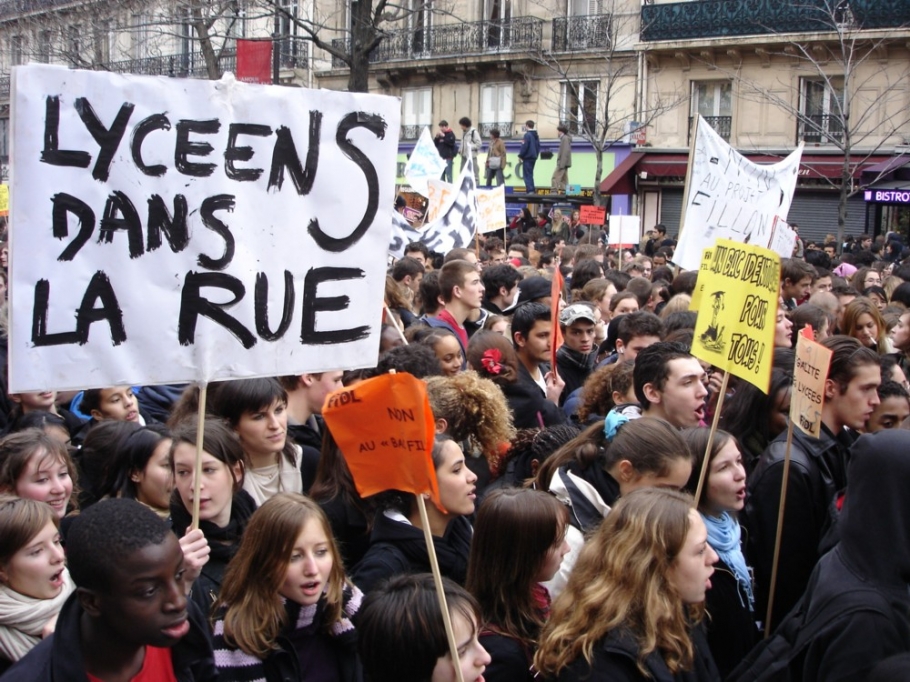
Prime Minister Sébastien Lecornu convened an emergency crisis meeting on Thursday and ordered government ministers to cancel planned travel, as a fast-growing wave of high-school student protests over underfunded schools spread nationwide across France, the Associated Press reported on October 1, 2026. The demonstrations, which began in Paris-region schools last week, have snowballed into one of the most disruptive youth movements in recent French memory — with hundreds of arrests, dozens of injuries, and more than a thousand schools affected.
Table of Contents
- From Paris Blockades to a Nationwide Movement
- What Students Are Demanding
- Violence on the Margins
- A Political Flashpoint
- The Government's Response
- Key Takeaways
- Frequently Asked Questions
- Sources
- Read Next on Chronicle
From Paris Blockades to a Nationwide Movement
The protests erupted around September 21 in lycées — France's high schools for 15- to 18-year-olds — in the Paris region and have since spread to nearly every corner of the country, including Lyon, Bordeaux, Toulouse, Nice, Strasbourg and Marseille. The scale is striking: police reported about 900 demonstrations, blockades and related incidents under way outside high schools across France by Thursday morning. The BBC, citing the Interior Ministry, counted 1,027 lycées affected and blockades at 222 schools, while roughly 30 university campuses — including in Paris and Marseille — were also blocked, a student union said. Authorities expected about 400 schools to remain closed on Friday, October 2, with some classes moving online.
The human cost has mounted quickly. Nearly 3,000 lycée students have been detained since the protests began, according to the Interior Ministry, including 1,949 on Thursday alone. More than 300 police officers — plus dozens of firefighters, teachers and pupils — have been injured. The Interior Ministry separately reported 625 detentions in recent days, a reminder of how fast the numbers have climbed as the unrest intensified.
What Students Are Demanding
The grievances are rooted in everyday classroom conditions. Students interviewed by AFP and the AP described class sizes near 35 pupils, temperatures above 35°C in summer heatwaves, water leaks in buildings, too few toilets, long school days running from 8 a.m. to 6 p.m., and chronic teacher shortages that leave classes uncovered.
At a Paris high school where students barricaded an entrance, 18-year-old Salama Gargouri told the AP that protesters wanted to target "overloaded schedules, the system, the teachers, people who don't listen to us, the university application process." In Strasbourg, a 17-year-old described the conditions to AFP as simply unacceptable: "There are 35 of us per classroom. With 35C in summer, it's unbearable. There aren't enough toilets, and there are water leaks in some rooms."
Violence on the Margins
Most of the blockades began peacefully, but arson, thrown projectiles and vandalism have flared on the margins of some protests — and the clashes have injured students and security forces alike. The Interior Minister ordered police to break up blockades preventing pupils from attending classes and to stop violence and vandalism, while tear gas has been deployed around several campuses.
Several incidents have drawn national attention. In Nantes, flames spread across the facade of Nelson Mandela High School; the city's mayor, Johanna Rolland, maintained the fire was set not by students but by anarchist groups that infiltrated the demonstrations, while deputy headmistress Gaëlle Cordier described it as an arson attack, Reuters reported. In Marseille, teachers at Victor Hugo high school were inadvertently splashed with petrol when a student tried to throw it into a rubbish bin — an episode the prosecutor's office had earlier described in graver terms — and youths at the Saint-Exupéry high school surrounded a firetruck, forced firefighters away and set the vehicle alight. In Strasbourg, at least one car was torched, and riot police clashed with youths in Toulouse.
A Political Flashpoint
The crisis has exploded into a political battlefield. According to a readout of Thursday's crisis meeting shared with reporters and reported by Reuters, France's intelligence agencies briefed the government that the movement was initiated by hard-left politicians: "Shared assessment by the intelligence services on the origin of the movement: an operation organised by LFI (France Unbowed) and its proxies on the far left," the readout stated. Hard-left lawmakers and local mayors have been accused by political opponents of fanning the movement by appearing in front of high schools.
France Unbowed flatly denied the charge. "LFI has always advocated non-violent demonstrations," LFI lawmaker Louis Boyard told BFM TV after the readout was shared. "The government, by turning it into a political battle, has added fuel to the fire by insulting and repressing high school students."
The timing is combustible. The protests are fast becoming a hot topic in the campaign to replace President Emmanuel Macron, who is constitutionally barred from seeking a third consecutive term next May. They are also piling pressure on a government wrestling with France's growing financial problems — overshadowing the release on Thursday of its proposed cost-cutting budget for 2027.
The Government's Response
Lecornu's office said the "upsurge in violence makes it virtually impossible to maintain the continuity of public education and is exposing staff and students to danger." Education Minister Édouard Geffray announced that classes should shift online whenever blockades or damage put students at risk — "Violence will not deprive our students of their fundamental right to education," he wrote on X — and was due to meet staff unions and parent and student groups on Friday. Student unions, meanwhile, have called a national day of protest for Tuesday, October 6, according to AFP and DW.
With demonstrations continuing and tensions rising, the coming days will test whether dialogue can calm the movement — or whether disruption, arrests and blocked campuses become France's new normal this autumn. While France contends with its domestic crisis, tensions are also rising across the Middle East, where the US has deployed a third aircraft carrier as it weighs renewed strikes on Iran — read our coverage of that military buildup.
Key Takeaways
- France's prime minister convened a crisis meeting on October 1, 2026 and ordered ministers to cancel travel as student protests over school conditions spread nationwide.
- Around 1,027 lycées have been affected and 222 blockaded, according to Interior Ministry figures reported by the BBC; about 400 schools were expected to stay closed on October 2.
- Nearly 3,000 students have been detained since the movement began, including 1,949 on Thursday alone; more than 300 police officers and dozens of others have been injured.
- Students are protesting overcrowded classrooms, teacher shortages, dilapidated buildings, long school days and extreme heat in classrooms.
- Intelligence agencies briefed that the hard-left LFI orchestrated the movement; LFI denies it. Student unions have called a national day of protest for October 6.
Frequently Asked Questions
Why are French students protesting?
High-school students are protesting underfunded and deteriorating school conditions: overcrowded classrooms of up to 35 pupils, teacher shortages, long school days, dilapidated buildings, and extreme heat in summer.
How widespread are the protests?
Roughly 1,027 lycées have been affected and 222 blockaded nationwide, with about 900 demonstrations and related incidents reported; around 30 university campuses have also been blocked.
How many people have been arrested?
Nearly 3,000 students have been detained since the protests began, including 1,949 on Thursday, October 1, according to the Interior Ministry.
What is the government's response?
Prime Minister Sébastien Lecornu convened a crisis meeting and asked ministers to cancel travel; the education minister ordered classes to move online where blockades or violence make schools unsafe and is meeting student representatives.
When is the next planned national protest?
Student unions have called a national day of protest for Tuesday, October 6.
Sources
- Associated Press — via LA Post — "France gripped by spreading student protests as PM calls crisis meeting," October 1, 2026.
- Reuters — via SRN News — "Crisis meeting told France's hardleft party behind school protests, says source," October 1, 2026.
- Informat.ro — Reporting on the Nantes school fire and crisis cell, October 1, 2026.
- PressTV — "France calls crisis meeting as schools go online amid spreading student protests," October 2, 2026.