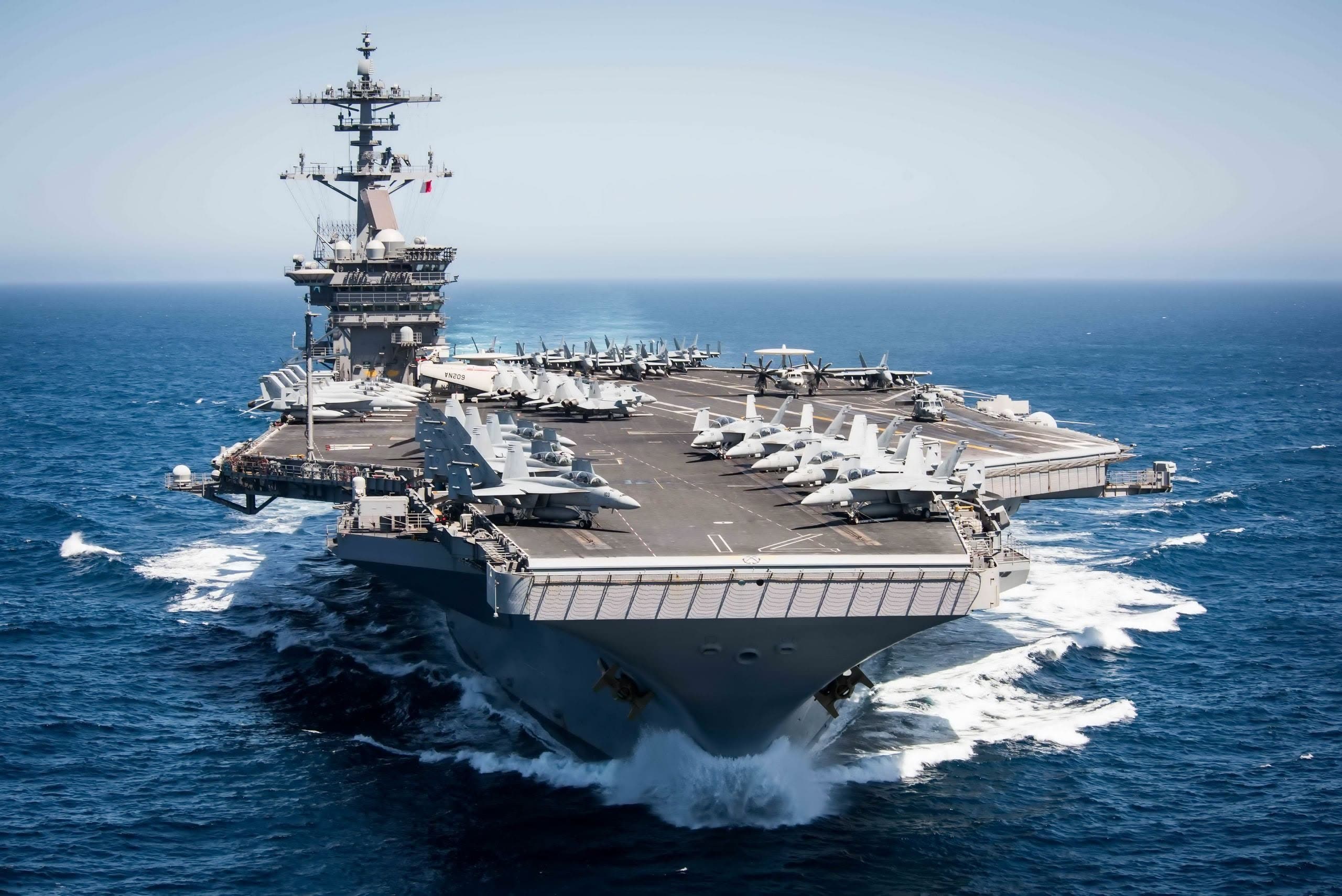
The United States is sending a third aircraft carrier strike group to the Middle East, alongside roughly 9,000 additional troops aboard warships including an amphibious force, as President Donald Trump weighs whether to resume bombing Iran after the November midterm elections, the Wall Street Journal reported on October 2, 2026. The USS Theodore Roosevelt carrier group departed San Diego this week bound for the region, joining two carrier groups already deployed, in what US officials describe as the largest concentration of American naval and air power near Iran since the war entered its eighth month.
The buildup, expected to be complete by November, would put total US personnel in the region near 50,000 according to some outlets. Trump has told aides he expects to resume strikes on Iran in November, following the midterms, after indirect negotiations with Tehran stalled when Washington rejected an Iranian proposal to reopen the Strait of Hormuz in exchange for lifting the American blockade. Oil prices, already elevated through months of conflict, rose further on the news.
Table of Contents
- A Third Carrier, 9,000 More Troops
- Trump's November Timeline and the Stalled Talks
- The Failed Hormuz-for-Blockade Proposal
- The War's Eighth Month: Oil Prices and Escalation Risks
- Key Takeaways
- Frequently Asked Questions
- Sources
- Read Next on Chronicle
A Third Carrier, 9,000 More Troops
The deployment announced this week marks a sharp escalation in the American military posture. According to the Wall Street Journal's October 2 reporting, the USS Theodore Roosevelt strike group left San Diego carrying thousands of sailors, and it is traveling with an amphibious ready group — ships configured to land Marine forces — meaning the total influx of personnel could approach 10,000. Two US carrier strike groups are already operating in or near the Persian Gulf region.
The stated purpose, per Pentagon officials quoted in the Journal's account, is deterrence: to pressure Tehran into concessions and to defend American bases and shipping from retaliation should Trump order new strikes. But the scale of the movement — three carriers, amphibious assault capacity, and fighter and bomber rotations — also gives the president a fully loaded arsenal should he choose the military option in November. Regional airbases in Qatar, Bahrain, the United Arab Emirates and Diego Garcia have already absorbed waves of American aircraft during the earlier phases of the campaign, and military planners have been quietly expanding munitions stockpiles for weeks.
Trump's November Timeline and the Stalled Talks
The timing is overtly political. Trump has told close aides, per the Journal, that he expects to resume bombing Iran in November, immediately after the midterm elections, a window that lets the administration pair a show of force with the electoral calendar. The two earlier rounds of US strikes — launched after Israel's initial campaign opened the war earlier this year — damaged Iranian nuclear and missile infrastructure but did not produce the decisive outcome the White House had predicted.
Between the rounds, indirect negotiations mediated by Gulf intermediaries continued. Those talks have now ground to a halt. According to the Journal's sources, Washington rejected the latest Iranian proposal outright, leaving the diplomatic channel effectively frozen at the moment the military buildup accelerates. For more on the daily shape of American policy in this period, see our coverage of American news today.
The Failed Hormuz-for-Blockade Proposal
The rejected proposal, as described in the Journal's reporting, would have traded reopening the Strait of Hormuz — the chokepoint through which roughly a fifth of the world's oil flows and which Iran has threatened or intermittently constrained during the war — for the lifting of the American naval blockade that has throttled Iranian exports. The administration judged the offer insufficient: it did not include the nuclear concessions Washington has demanded since the war began.
Iran's gambit reveals the war's economic vise. The blockade has been one of Washington's most effective non-kinetic weapons, starving Tehran of hard currency while the bombing campaigns targeted its military assets. Tehran, in turn, has learned that the Hormuz card — threatening global energy supplies — is its most potent leverage, and has been willing to bargain it. That the two sides could not bridge the gap before the third carrier sailed suggests the next phase of the war is more likely to be decided by force than by talks. Readers can find the full background on the man who once led Iran during its last confrontation with Washington in our Ahmadinejad feature.
The War's Eighth Month: Oil Prices and Escalation Risks
Eight months into the war, the regional order is unrecognizable. Oil prices have climbed steadily since fighting began, with traders now pricing in the risk of a November strike wave, and the global economy — already strained by a series of European debt crises this autumn — is absorbing the shock. European governments have urged restraint, and Gulf states hosting US bases have quietly pressed Washington to keep their territories out of any retaliatory fire from Iranian missiles.
Iran has signaled, through state media and proxy channels, that American personnel and installations in the region would be targeted if a third wave of strikes begins. With some outlets estimating as many as 50,000 US personnel spread across the theater, the escalation risk is material: a force built to threaten Iran is also a force exposed to Iranian retaliation. Whether the Roosevelt's arrival is the prelude to a negotiated settlement or to a November bombing campaign will define the final months of 2026.
Key Takeaways
- The US is deploying a third aircraft carrier strike group, led by the USS Theodore Roosevelt, plus an amphibious force carrying roughly 9,000 additional troops, to the Middle East (Wall Street Journal, October 2, 2026).
- The buildup is expected to be complete by November, with total US personnel in the region estimated near 50,000 by some outlets.
- Trump has told aides he expects to resume bombing Iran in November, after the midterm elections.
- Indirect talks stalled after Washington rejected an Iranian proposal to reopen the Strait of Hormuz in exchange for lifting the American naval blockade.
- Oil prices, elevated through eight months of war, rose further on the deployment news.
Frequently Asked Questions
Which carrier is the US sending to the Middle East?
The USS Theodore Roosevelt carrier strike group, which departed San Diego this week, according to the Wall Street Journal. It joins two carrier strike groups already deployed in the region.
How many additional troops are being deployed?
Roughly 9,000 additional personnel aboard ships including the carrier group and an accompanying amphibious ready group, with some estimates putting total US personnel in the region near 50,000.
When might the US resume strikes on Iran?
President Trump has told aides he expects to resume bombing Iran in November, after the midterm elections, per the Journal's October 2 reporting.
Why did negotiations with Iran stall?
Indirect talks froze after Washington rejected an Iranian proposal to reopen the Strait of Hormuz in exchange for lifting the American blockade, judging it insufficient without nuclear concessions.
How long has the war been going on?
The conflict is now in its eighth month, with oil prices elevated throughout as markets price in disruption to energy shipments through the Strait of Hormuz.
Sources
- Wall Street Journal — wsj.com — Reporting on the third carrier deployment, the November strike timeline and the stalled Iran talks, October 2, 2026.
- Daily Brief — dailybrief.net — October 2, 2026 edition.